Anyone who has remodeled a kitchen knows the order. The plumber comes first, then the electrician, then the drywaller, then the painter. Each one waits for the one before. When the drywaller finds that a pipe sits where the cabinet goes, the plumber comes back, and the drywall comes down. A job with a few days of real work takes two months, and most of those months are waiting.
A good handyman does it differently. One person plumbs, wires, hangs the drywall and paints, and fixes their own mistakes the same afternoon. There's one exception. When the wiring is done, the city inspector still comes and looks, because the handyman can't be the one who signs off their own wiring.
I've been thinking about that kitchen because knowledge work is built like the first job, and AI is making the second one possible.
The claim
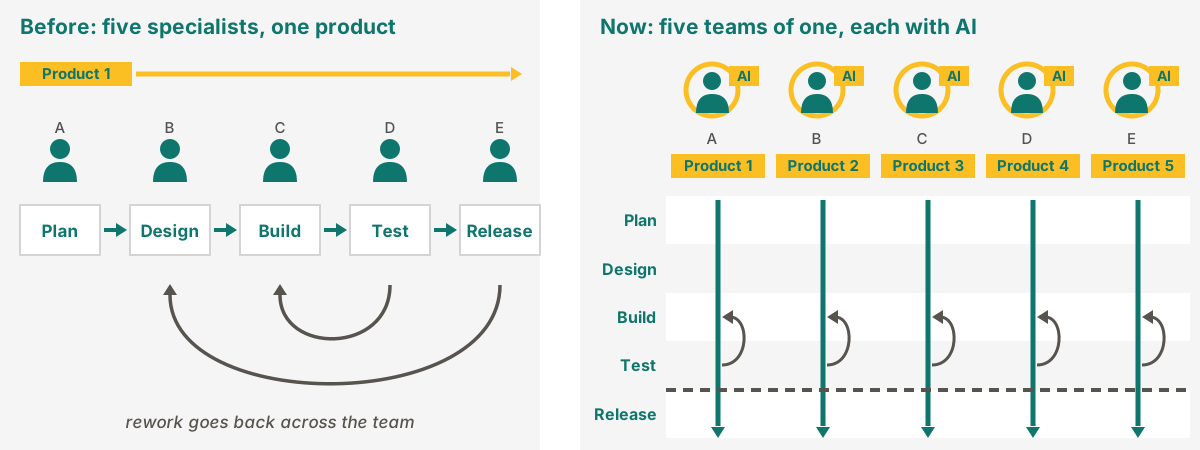
For a century we have organized knowledge work as a relay of specialists. An analyst writes the requirement, a designer designs, a developer builds, a tester tests, and someone else releases. Handoffs belonged to that age of specialists. With AI, one capable person can carry a piece of work through every role, and the same five people who used to hand work to each other can become five teams of one. The roles don't disappear. The handoffs between people do, except the one that checks the work.
Here is the picture. On the left, product 1 crosses five people, one role each, and rework goes back across the team. On the right, the same five people, each with AI working alongside them (the gold ring), carry their own product down through all five roles. Rework still happens, but inside one person, in minutes. The dashed line before release is the inspector: an independent review.
Key point: Drop the handoffs that only move the work. Keep the ones that check it.
Why the relay existed, and what it cost
Specialization paid. Adam Smith's pin factory in The Wealth of Nations (1776) split pin-making into about eighteen steps, and ten workers made upwards of 48,000 pins a day. One worker alone, Smith guessed, could not make twenty. Knowledge work copied the factory and gave each step its own person and its own queue.
The cost was harder to see, because the inventory is information, not pins. Don Reinertsen's The Principles of Product Development Flow (2009) states it flatly: queues are the root cause of most of the economic waste in product development, and few teams measure them. DORA's research names the mechanism in software: work gets done in large batches because handing off changes has a large fixed cost.
Every generation has tried to shrink the relay. Toyota put engineers from different functions on the same problem early. Agile put the roles in one team. At Amazon in 2006, Werner Vogels described teams that scope, build and operate their own service: "You build it, you run it." Each step moved the handoffs inside a team. None got the unit down to one person, because one person couldn't hold every specialty.
The team of one, measured
That is what changed. In 2024 Procter & Gamble ran a field experiment with 776 of its own professionals on real product problems (Dell'Acqua, Mollick and colleagues, "The Cybernetic Teammate"). People worked alone or in pairs, with or without AI, and experts judged the ideas.
| Setup | Quality gain over one person without AI |
|---|---|
| Two people, no AI | +0.24 standard deviations |
| One person with AI | +0.37 |
| Two people with AI | +0.39 |
One person with AI matched a two-person team without it. The second finding matters more for this argument. Without AI, R&D people proposed technical ideas and commercial people proposed commercial ones. With AI, both proposed balanced ideas. The tool filled in the lane each person lacked, which is exactly what a team of one needs.
The person who can do it
Playing five roles is a particular kind of job, and there's a name for the person who is good at it. In a 2015 TEDx talk that has been played more than nine million times, Emilie Wapnick called them multipotentialites: people with many interests and creative pursuits. She names three strengths:
- Idea synthesis. They combine fields and make something new where the fields meet.
- Rapid learning. They are beginners often, so they get good at starting from zero.
- Adaptability. They take on whatever role the situation needs.
A specialist has one deep skill. A T-shaped person adds breadth across the top. A multipotentialite goes deep in several fields, like the teeth of a comb. AI makes each extra tooth cheaper to grow. It doesn't supply judgment in each field, so the skill that matters is the second one on Wapnick's list: learning a new field quickly and completely, well enough to judge the work in it.
Are people born this way? Partly. Openness to experience, the personality trait closest to curiosity, is about 40 percent heritable across 134 studies. But curiosity can be trained: a 2023 review of 41 randomized trials found that it rose with practice, though most studies measured it only in the weeks afterwards. Wapnick herself makes no biological claim. She says the pressure to specialize comes from culture. A career across several fields is mostly choice and practice, which means it can be taught.
How to learn a field fast
When I walk into a field I don't know, I tell the AI so. I say that I don't know the vocabulary, and I ask it to name the industry term for whatever I describe. After a few rounds I can talk to people in that field. That habit is one step in a loop I now teach:
- Get interviewed. Ask the AI to ask you one question at a time about the field and your goal.
- Learn the words. Ask it to name the term for what you just described.
- Try it on real work. One small task, the same day.
- Check with an expert. They see what looks right but isn't.
- Explain it back. Without notes, a few days later.
The last two steps are the ones AI can't do for you. Step five has the strongest evidence behind it: a 2013 review of ten study techniques rated testing yourself and spacing out practice highest, and rereading and highlighting lowest.
Step four has a story behind it. A couple of years ago I generated a picture of a crane and posted it. It looked right to me. A friend who has spent years watching cranes wrote back that it was the wrong species. I had no way to see it, and he couldn't miss it. That is the whole risk of the team of one in one picture.
Where the team of one goes wrong
The tension is depth against span. You can cover more of the workflow, or you can judge each step, and the relay traded one for the other.
Principles of Disruptive Innovation
Every truly disruptive innovation ultimately solves a contradiction.
Every solved contradiction was once an un-solved contradiction.
When you solve a contradiction, express the contradiction that you solved — as a contradiction.
Matrix Morphology framework from David Quimby & Innovation Radiation Associates.
Q2, the Generalist With AI, is where most of the new capability will be spent badly. The evidence is already in. In the BCG study of 758 consultants, those using AI on a task just outside what AI does well got the right answer about 19 points less often than those without it. In a 2025 METR study, experienced open-source developers were 19 percent slower with AI while believing they were 20 percent faster.
Q4, the Team of One, gets both span and depth three ways: learning each new field fast enough to judge it, calling a specialist at the edge of what they know, and keeping an independent review before release. The specialists don't vanish. They move from the relay to the consult.
Key point: The team of one is only as good as its judgment in its weakest lane. That's why learning to learn is the skill to build first.
The queue moves to review
Goldratt's rule is that when you relieve a constraint, it moves. Take the handoffs out of building, and the queue shows up in front of review. Faros AI's telemetry across more than 10,000 developers found 98 percent more pull requests merged and 91 percent longer review times as AI use grew. That's vendor data, but it matches what teams describe. Shopify's CEO said this month that colleagues now throw unread AI output at each other for someone else to check.
So a team of one needs a reviewer who is independent and has time. In regulated work that matters twice over. For medical devices, the FDA's old design-control rule required a reviewer with no direct responsibility for the design stage under review. The new Quality Management System Regulation, in force since February 2026, dropped that explicit requirement in favor of ISO 13485, and the FDA says it still values independent review. The inspector still comes to look at the wiring.
What to do next
Start with the relay you already have. Draw your workflow and mark every handoff. For each one, ask whether it moves the work or checks it. The ones that move work are candidates for a team of one, first in stages where the work gets a fast, clear grade, like code with tests. The ones that check work stay, and they need more reviewer time, not less.
Then look at your people. The ones who pick up a new field quickly, connect it to their own, and know when to call an expert are the ones ready to carry a product end to end. Some of them were born curious. The rest can learn the loop.
The open question is how far one person can stretch before depth runs out. P&G measured one day of work. Nobody has measured a year of it yet.
This post comes from a session in the netrii Wisdom Library — The Team of One, 2026-09-23, which records every source. It follows The Business Engineer, which makes the same argument at the scale of a whole business.